The group celebrates its 20th anniversary with a concert on May 3
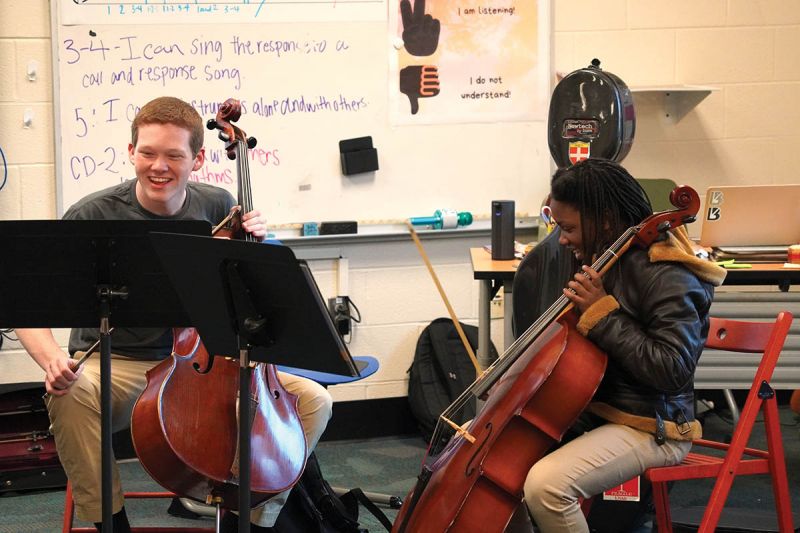
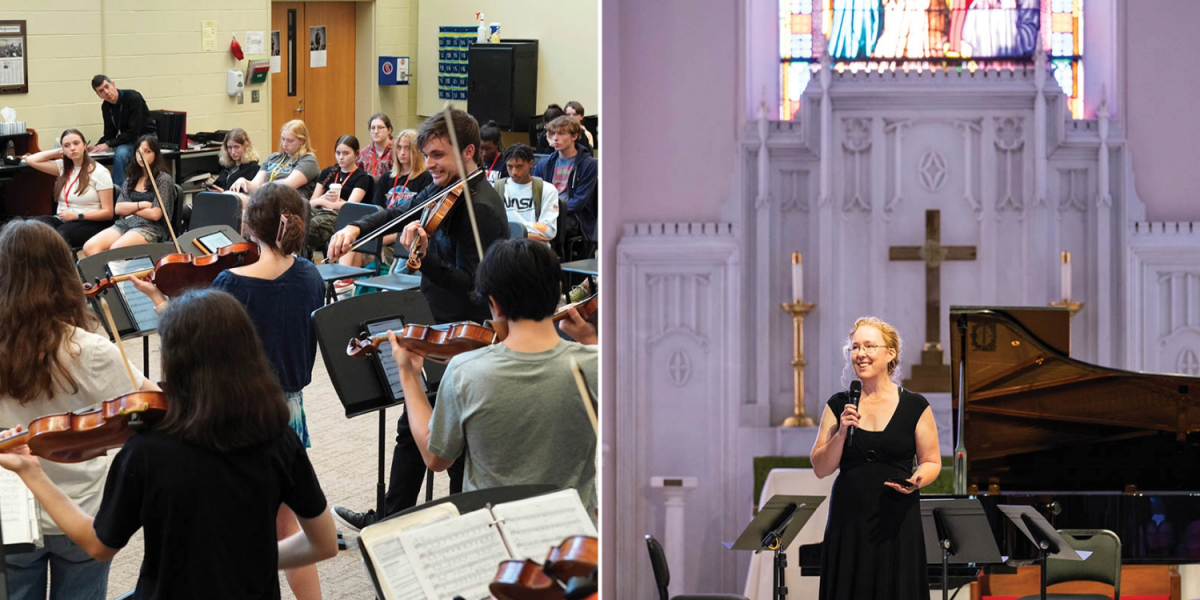
Chamber Music Charleston’s coaching program pairs student quartets and sextets with adult performers.
No other genre has the staying power of classical music. Attend a concert hosted by Chamber Music Charleston (CMC), and you’re likely to hear music performed similarly to how it sounded centuries ago (and often in the same spaces like Society Hall and the Old Exchange Building). “Before we were even a country, Charleston was one of the few centers of culture in the New World,” says Sandra Nikolajevs, who founded CMC in 2006 and serves as its president and artistic director. “Chamber music offers a more individual, intimate, and accessible version of classical music. We had these incredible chamber musicians living in Charleston in the late 1700s, and the top musicians from around the world would come to perform with them, and that’s exactly what we’re doing now.”
CMC celebrates its 20th anniversary this spring with a string of performances and a heightened emphasis on its educational programming and instruction for the next generation of musicians. Its Youth Chamber Music Initiative includes children’s concerts, professional coaching for high school students, and an annual residency at the Charleston County School of the Arts (SOA) with renowned Spanish violinist Francisco Fullana, who visited the school for a week this March for the fifth consecutive year.
“It’s a highlight of my year to be able to develop these friendships in Charleston,” says Fullana, who emphasizes an individual’s sound within a performance format known for rigidity. “I show them how technique is flexible and how much of a difference you can make,” he explains. “The subtle ways one plays Mozart are very different than the way you play Tchaikovsky. Each composer should be approached like a different language—when you focus on the nuance and listen, you use texture and sound to bring a piece to life.”
Dr. Christopher Selby, SOA’s director of high school orchestras, credits the partnership with CMC and Fullana with helping to build his students’ confidence. And it’s paid off—SOA won its second national competition in 2023 for a program first performed at the Sottile Theatre. “Watching someone of that caliber work with my kids helps me to see areas that I can focus on,” says Selby, who shares Fullana’s passion for “unconducted orchestras.” “Being unconducted puts the responsibility for counting and listening on the individual player,” he says. “When the kids are actively involved and reacting to each other, it generates a more powerful musical experience.”
Many of Selby’s students also participate in the CMC TWO program, which pairs chamber groups (generally quartets or sextets) with adult mentors from CMC. In chamber music, a violinist or cellist can’t rely on the comfort of other musicians playing the same part. “The skills my students develop in the smaller chamber groups carry over into their performances with the larger orchestra,” he says.
Even before most children are ready to perform, CMC programming instills an appreciation for the music through concerts hosted at elementary schools, primarily on John’s Island. “Our goal with children’s performance is just to give them a great memory of a classical music experience,” says Nikolajevs. “We’re instilling a love for the art form, and that helps Chamber Music Charleston to continue.”
Most CMC youth participants won’t become professional musicians (although one former student, Jonathon Heyward, is now the music director of the Baltimore Symphony Orchestra), but they may continue to play and will likely attend chamber music concerts as adults. “Our philosophy is to do everything with the very best people we can do it with,” says Nikolajevs. “Chamber music is entrenched here and has a really vibrant future in Charleston.”